Urgency, Opportunity, and the Road Ahead for Community Solar Lending
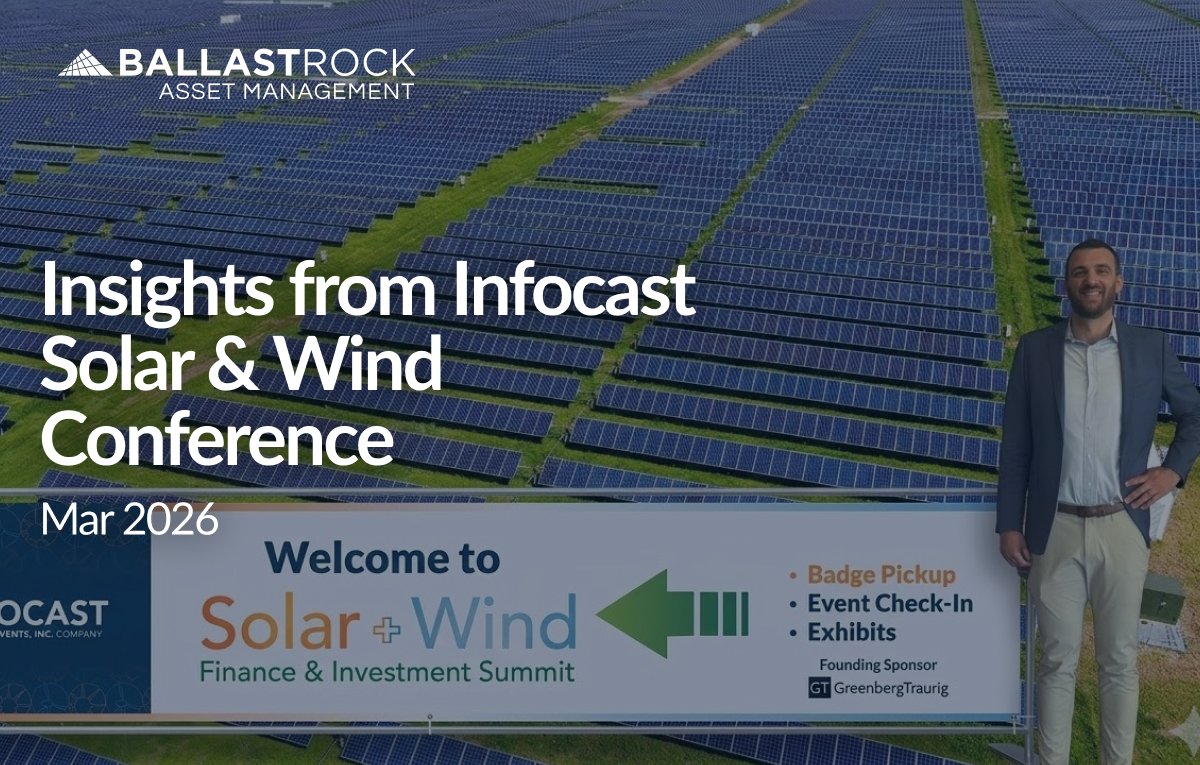
Reflections from the 2026 Infocast Solar + Wind Finance & Investment Summit in Phoenix, where the post-OBBB Act landscape dominated the conversation—and reinforced the case for our lending strategy.
Infocast Conference: Key Themes For Our Private Credit Fund
Compressed timelines create lender demand. The July 2026 construction commencement deadline, introduced by the One Big Beautiful Bill, is driving an acceleration in developer activity, particularly for pre-NTP financing where speed and solar-specific expertise are critical differentiators.
Preserved transferability supports borrower economics. The continued ability to sell tax credits keeps the community solar capital stack viable for smaller developers, improving the creditworthiness of our loan portfolio.
Specialized lending fills a market gap. Large-platform lenders struggle to serve the $1–5M distributed generation segment efficiently. Developers repeatedly cited this as a pain point—and an opportunity for lenders like us.
Subscriber economics are strengthening. Rising retail electricity rates improve the savings proposition for community solar subscribers, reinforcing the revenue assumptions which drive the value of the projects underlying our loans.
Last week, more than 2,500 renewable energy developers, investors, lenders, and advisors gathered at the Arizona Biltmore in Phoenix for the 2026 Infocast Solar + Wind Finance & Investment Summit—widely regarded as one of the industry’s most important annual deal-making events. I attended on behalf of Ballast Rock’s private credit fund, which focuses on pre-NTP financing for community solar projects. The conference confirmed several themes that are central to our lending thesis and surfaced new dynamics that will shape how we continue to deploy capital over the next twelve months.
The OBBBA Act Has Created a Deadline
If there was one overriding theme at the summit, it was the impact of the One Big Beautiful Bill (“OBBB”) Act, signed into law in July 2025. The legislation preserved much of the Inflation Reduction Act’s clean energy framework but introduced hard deadlines that have fundamentally altered the pace of the market. Projects that begin construction by July 4, 2026, remain eligible for production and investment tax credits under the existing rules. Projects starting after that date face a compressed placed-in-service deadline of December 31, 2027—a timeline that many developers consider impractical for all but the most advanced pipelines.
For community solar developers, this creates both urgency and opportunity. The developers we lend to—those building 1–5 MW distributed generation projects across multiple states—are moving aggressively to establish construction commencement before the July 2026 cutoff. That acceleration is translating directly into demand for the type of pre-NTP and early-stage financing that our fund provides. The conversations I had in Phoenix made clear that capital availability at this stage of the project lifecycle is becoming a genuine bottleneck, and lenders who understand community solar fundamentals are in a strong position.
Tax Credit Transferability Survived
One of the most consequential provisions of the OBBB Act for the distributed generation sector is the preservation of tax credit transferability under Section 6418. Earlier versions of the bill had proposed eliminating this mechanism, which would have been a significant blow to smaller developers who lack the tax appetite or the scale to attract traditional tax equity partners. The final legislation kept transferability intact, with restrictions only on transfers to certain foreign entities.
This is important for our lending strategy because transferability is often the primary monetization path for the community solar projects in our portfolio. When we underwrite a pre-NTP loan, we are evaluating whether a developer can convert their project into a financeable, operational asset. A functioning credit transfer market reduces the complexity and cost of that conversion, making our borrowers’ capital stacks more predictable and our collateral more secure.
The Evolving Capital Stack Creates Space for Specialized Lenders
A recurring theme across panels and side conversations was the increasing diversity of financing structures available to renewable energy developers. The industry has moved well beyond the traditional project finance model. Developers are now accessing corporate revolvers, bridge-to-COD facilities, standby letter of credit lines, and various hybrid structures that blend corporate and project-level lending. Several lenders and advisors described the solar development financing landscape as increasingly competitive, with banks and specialty finance providers alike looking for ways to differentiate their offerings.
For Ballast Rock, this landscape validates our positioning. We operate in a specific segment of the capital stack—pre-NTP for distributed generation community solar—where project-level expertise matters more than scale. Our borrowers are typically too small for the large bank platforms to efficiently serve, but their projects are well-structured and supported by established state-level community solar programs. We heard repeatedly from developers that finding a lender who can move quickly, evaluate a community solar project on its own merits, and close in the $1–5 million range remains a challenge. That is precisely the niche we occupy.
Power Pricing and Subscriber Economics Remain Favorable
Multiple sessions examined the trajectory of wholesale and retail power prices, with particular attention to the impact of natural gas prices, which have roughly doubled over the past year and are expected to see continued increases as data center energy demand grows. As discussed by multiple expert panelists, data centers constitute 5% of energy demand today but are expected to reach 20% of energy demand by 2030, pushing power prices up as a result. Rising utility rates have complex effects across the renewable energy sector, but for community solar specifically, the dynamic is largely favorable: higher retail electricity prices widen the savings that subscribers receive through community solar credits, strengthening the value proposition that underpins subscriber acquisition and retention.
That said, the conference was clear-eyed about risks. Community solar program complexity, state-level policy variability, and subscriber management all remain operational challenges. Sessions on portfolio financing reinforced that lenders and investors are most comfortable when subscriber pools are well-diversified and include a meaningful share of creditworthy offtakers. Our underwriting has always emphasized these factors, and it was encouraging to see the broader market converging on the same risk framework.
Relationships and Visibility
Beyond the substantive takeaways, the networking value of Infocast cannot be overstated. The conference brought together major law firms active in project finance, data and analytics providers offering new tools for project valuation and due diligence, and—most importantly for us—dozens of developers actively seeking construction and bridge financing for community solar portfolios. Several of those conversations have already advanced to follow-up calls and potentially term sheet discussions.
For a boutique alternative investment manager, being present at the industry’s flagship event signals commitment and intent. It demonstrates to developers, co-lenders, and industry partners that we are not passive capital providers but informed participants in the broader community solar ecosystem. That credibility compounds over time and directly supports our origination efforts.
Looking Ahead
The community solar and broader distributed generation solar market is entering a pivotal stretch. The post-OBBB environment has created a defined window during which developers must act, capital must be deployed, and projects must advance. For our fund, this is an environment that rewards exactly what we offer: speed, sector expertise, and a willingness to lend at the pre-NTP stage where many other capital providers cannot or will not operate. The insights and relationships from this year’s summit will be instrumental as we execute against our deployment plan over the next twelve months.
* Ballast Rock Asset Management (“BRAM”), Ballast Rock Private Wealth (“BRPW”), and Ballast Rock Capital (“BRC”) are operating entities of Ballast Rock Holdings (“BRH"), an integrated investment management company. Ballast Rock Asset Management is a non-registered entity. Ballast Rock Real Estate is a wholly owned subsidiary of BRAM. BRPW is a registered investment advisor. BRC is a registered Broker dealer and a MEMBER of FINRA / SIPC. BRC’s registered head office is 460 King Street, Suite 200, Charleston, SC, 29403. Tel: 800-204-2513. To check background information about BRC and its representatives, visit FINRA’s BrokerCheck. Please see important disclosure information in our Form CRS